
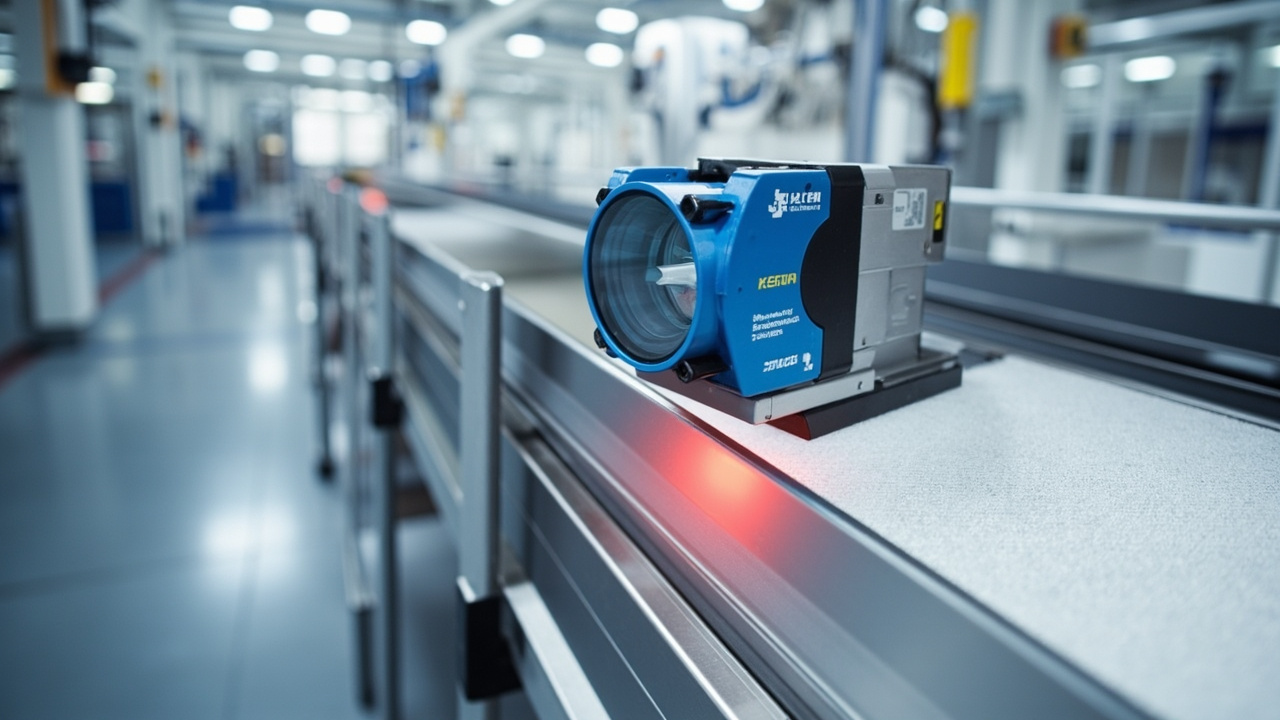
SICK Photoelectric Sensors for Industrial Automation
Discover SICK photoelectric sensors at Valley International Supply for reliable object detection and precise positioning in your manufacturing lines. Enhance efficiency and accuracy with leading-edge sensing technology.
At Valley International Supply, we understand that precision and reliability are paramount in modern manufacturing. That’s why we proudly offer a comprehensive range of SICK photoelectric sensors, engineered to provide unparalleled object detection and positioning capabilities for your industrial automation lines. As a trusted distributor and OEM representative for leading global manufacturers, including SICK, we bring you cutting-edge technology backed by our extensive technical expertise and personalized service.
SICK is a global leader in sensor technology, renowned for its innovative solutions that drive efficiency, safety, and productivity across diverse industries. Their photoelectric sensors are a cornerstone of industrial automation, offering robust performance in challenging environments and delivering accurate data for critical decision-making. Whether you need to detect the presence of an object, measure its position, or count items on a conveyor, SICK sensors provide the reliability and versatility your operations demand.
Why Choose SICK Photoelectric Sensors for Your Manufacturing Line?
Manufacturing processes rely on accurate and consistent data to maintain quality, optimize throughput, and minimize downtime. SICK photoelectric sensors are designed to meet these rigorous demands, offering a host of benefits that directly impact your bottom line:
- Exceptional Reliability: Built to withstand harsh industrial conditions, SICK sensors deliver consistent performance, reducing unexpected stoppages and maintenance needs.
- High Precision: Achieve exact object detection and positioning, crucial for quality control, assembly, and packaging applications.
- Versatile Applications: From detecting transparent objects to operating in dusty or wet environments, SICK offers a sensor solution for nearly every challenge.
- Enhanced Efficiency: Automate tasks that were previously manual, speeding up production cycles and reducing labor costs.
- Improved Safety: Implement safety functions by reliably detecting personnel or machinery in hazardous zones.
- Easy Integration: Designed for seamless integration into existing and new automation systems, minimizing installation time and complexity.
- Reduced Waste: Accurate sensing helps prevent errors, leading to less material waste and rework.
Understanding SICK Photoelectric Sensor Technologies
SICK offers a diverse portfolio of photoelectric sensors, each utilizing specific principles to address various application requirements. Understanding these technologies is key to selecting the right sensor for your needs:
1. Through-Beam Photoelectric Sensors
- Principle: Consist of a separate transmitter and receiver. The transmitter emits a light beam, and the receiver detects it. An object is detected when it interrupts the beam.
- Advantages: Long sensing ranges, high excess gain (meaning they can reliably detect objects even with some contamination), and excellent reliability for detecting opaque objects.
- Typical Applications: Perimeter guarding, large object detection, long-distance sensing, counting applications.
2. Retro-Reflective Photoelectric Sensors
- Principle: Combine the transmitter and receiver in a single housing. The light beam is sent to a reflector, which bounces it back to the sensor. An object is detected when it interrupts the beam between the sensor and the reflector.
- Advantages: Easier wiring and installation than through-beam sensors, good sensing ranges, and effective for detecting most opaque objects.
- Special Variants: Some models are designed for detecting transparent objects (e.g., glass, plastic films) by recognizing subtle changes in the reflected light.
- Typical Applications: Pallet detection, packaging lines, material handling, detecting objects on conveyors.
3. Diffuse Photoelectric Sensors (Proximity Sensors)
- Principle: The transmitter and receiver are in a single housing. The sensor emits light, and an object is detected when it reflects enough light back to the receiver. The object itself acts as the reflector.
- Advantages: No separate reflector or receiver needed, making installation very simple. Ideal for short-range detection.
- Considerations: Sensing range is dependent on the object’s color, surface texture, and reflectivity. Background suppression models can ignore objects beyond a set distance.
- Typical Applications: Small part detection, presence sensing, door/gate monitoring, fill level detection.
4. Photoelectric Sensors with Background Suppression (BGS)
- Principle: A type of diffuse sensor that can reliably detect objects regardless of their color or surface, while ignoring backgrounds that are further away. This is achieved by using triangulation principles.
- Advantages: Highly reliable detection of objects even against complex or reflective backgrounds, consistent sensing range regardless of object color.
- Typical Applications: Robotic gripping, precise positioning, detection of objects on shiny conveyor belts, assembly verification.
5. Photoelectric Sensors with Foreground Suppression (FGS)
- Principle: Designed to ignore objects in the foreground and only detect objects that appear beyond a certain distance. Useful for applications where objects might temporarily obstruct the sensor’s view but are not the target.
- Advantages: Prevents false triggers from dust, debris, or small objects close to the sensor.
- Typical Applications: Monitoring access points, detecting larger objects behind a protective barrier.
Key Considerations for Selecting Your SICK Photoelectric Sensor
Choosing the optimal SICK photoelectric sensor involves evaluating several factors specific to your application:
- Sensing Range: How far does the sensor need to detect an object? This will influence the sensor type (through-beam for long ranges, diffuse for short).
- Object Characteristics: What are the size, color, material, and surface texture of the objects to be detected? (e.g., transparent, shiny, dark, small).
- Environmental Conditions: Will the sensor operate in dusty, wet, high-temperature, or vibrating environments? Consider IP ratings and robust housing materials.
- Mounting Space: How much space is available for sensor installation? Compact designs are available for tight areas.
- Output Type: Do you need NPN or PNP outputs? Analog outputs for distance measurement? IO-Link for advanced communication?
- Response Time: How quickly does the sensor need to react to object presence or absence?
- Background/Foreground: Are there any reflective backgrounds or interfering objects that need to be suppressed?
- Special Features: Do you require features like teach-in functionality, adjustable sensitivity, or integrated diagnostics?
Our team of technical experts at Valley International Supply can guide you through these considerations, ensuring you select the SICK photoelectric sensor that perfectly aligns with your operational requirements and budget.
Enhancing Your Operations with Valley International Supply
When you partner with Valley International Supply for your SICK photoelectric sensor needs, you gain more than just a product; you gain a dedicated partner committed to your success. Our comprehensive support includes:
- Expert Consultation: Our experienced engineers provide tailored recommendations, helping you identify the most effective SICK sensor solutions for your unique challenges.
- Broad Product Portfolio: Access to a wide array of SICK photoelectric sensors, ensuring we can match the right technology to your specific application.
- Seamless Integration Support: Assistance with integrating SICK sensors into your existing or new automation systems, minimizing disruption and maximizing uptime.
- Reliable Supply Chain: As a trusted distributor, we ensure timely delivery of high-quality SICK products to keep your operations running smoothly.
- Long-Term Partnership: We build lasting relationships by offering ongoing support, technical advice, and solutions that evolve with your manufacturing needs.
Applications Across Industries
SICK photoelectric sensors are indispensable across a multitude of manufacturing and distribution sectors, including:
- Automotive: Assembly line part detection, robotic guidance, paint shop monitoring.
- Food & Beverage: Packaging inspection, fill level control, bottle and can counting.
- Pharmaceutical: Tablet counting, blister pack inspection, label presence detection.
- Logistics & Warehousing: Conveyor control, pallet positioning, automated storage and retrieval systems (AS/RS).
- Machine Building: Tool presence detection, safety guarding, component positioning.
- Electronics: PCB handling, component placement verification.
Ready to Optimize Your Object Detection and Positioning?
Don’t let outdated or unreliable sensing technology hinder your manufacturing efficiency. Upgrade to the precision and reliability of SICK photoelectric sensors, supplied and supported by the experts at Valley International Supply.
Our team is ready to discuss your specific application, provide detailed product information, and offer engineering recommendations that will enhance your operational performance. Contact us today to learn how SICK photoelectric sensors can transform your industrial automation processes.
Frequently Asked Questions
How do I know which type of SICK photoelectric sensor is right for my application?
Choosing the correct sensor depends on factors like sensing range, object material, environmental conditions, and available mounting space. Our technical experts can help you evaluate your specific needs and recommend the most suitable SICK sensor technology, whether it’s through-beam, retro-reflective, or diffuse.
Can SICK photoelectric sensors detect transparent objects like glass or plastic?
Yes, SICK offers specialized retro-reflective photoelectric sensors designed specifically for detecting transparent objects. These sensors use advanced optics and algorithms to reliably sense subtle changes in light, ensuring accurate detection of clear materials that standard sensors might miss.
What does ‘background suppression’ mean for a photoelectric sensor?
Background suppression (BGS) is a feature in diffuse photoelectric sensors that allows them to reliably detect an object at a set distance while ignoring any background objects or surfaces beyond that distance. This is particularly useful in applications where the background might be reflective or have varying colors, ensuring only the target object is detected.
Are SICK photoelectric sensors difficult to integrate into existing systems?
SICK sensors are designed for ease of integration. Many models offer standard output types (NPN/PNP) and communication interfaces like IO-Link, which simplifies connectivity to PLCs and control systems. Our team can provide guidance on seamless integration into your current automation infrastructure.
What kind of environment can SICK photoelectric sensors operate in?
SICK manufactures a wide range of photoelectric sensors with various IP ratings and robust housing materials, allowing them to operate reliably in diverse industrial environments. This includes areas with dust, moisture, high temperatures, or vibrations. We can help you select a sensor with the appropriate environmental protection for your specific operating conditions.
Can Valley International Supply help with the installation and setup of SICK sensors?
While we do not perform direct installation, our technical team provides comprehensive support and engineering recommendations to ensure successful integration and setup of your SICK photoelectric sensors. We can guide you through the selection process and offer advice on optimal placement and configuration for your application.
Manufacturers & sources referenced
This article references products from the following manufacturers. Learn more on their official sites:
About Valley International Supply
Valley International Supply is a distributor and OEM manufacturer representative of industrial automation equipment, serving manufacturers across the United States and Mexico for over 30 years. We supply PLCs, drives, HMIs, sensors, pneumatics, safety systems and connectivity components, backed by engineering selection assistance and technical support. Contact us at inquiry@valleyintlsupply.com or +1 (956) 338-0631.